I wrote the first version of this in early 2024, and it was a list of apps: task managers, calendars, location reminders, from free to premium. The only part of it that mattered was the principle under the list, which is that my short-term memory leaks, so I stop trusting it and put everything somewhere outside my head.
That hasn’t changed. What changed is how a thought gets out of my head, because every app on that list had the same weak point. I had to take out my phone, unlock it, and find the app, and by then I’m looking at a notification and the thought is gone. It’s that ADHD part of my brain, I’ll forget a noun in the middle of using it.
Before the ring
In early 2025 I started recording with the Voice Memos app on my iPhone and feeding the transcripts through Claude to organize my to-dos for work, and it was effective enough that I started thinking about a piece of hardware for it. A couple of months later I made a shortcut that took all the text entries I’d made that day, with their metadata, and handed them to Claude at the end of the day so I’d have a record of my thoughts. I posted at the time that we don’t need an AI pin, just good old voice memo. Heh.
The ring
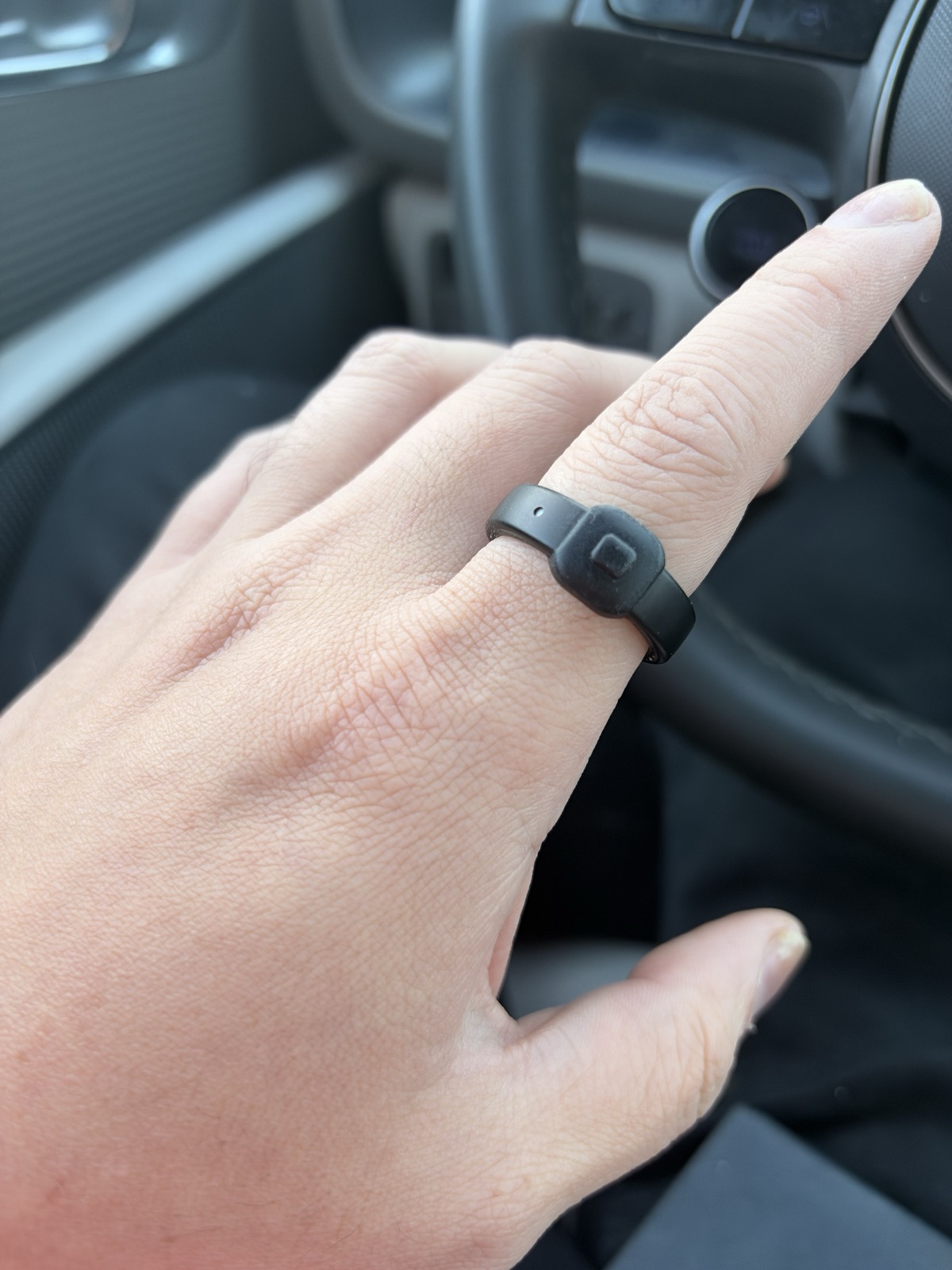
It’s a Pebble Index 01, a ring with one button whose whole job is to record me. I press and hold, say the thing, and let go. There’s no screen and no app to open, which means there’s nothing to get distracted by on the way to the thought.
My first note is from November 2, 2026, at 8pm. I was driving and listening to the creator of the ring talk about it on YouTube, so I held the button down and recorded myself over him, to test whether the microphone would pick me out. It did.
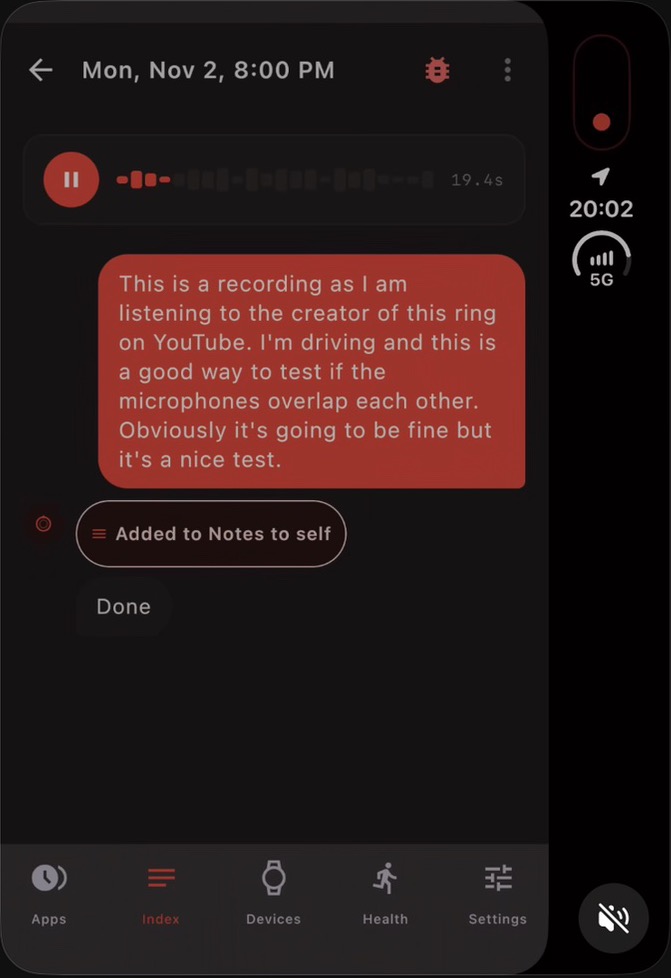
In the fifteen days since then I’ve recorded 231 thoughts, about 15 a day, and the average one is 39 words long (the longest ran to 297, I talk).
Why it’s built this way
The ring comes from Eric Migicovsky, the founder of Pebble, the smartwatch company, and he calls it external memory for your brain. His reason for making it is the same leak I’ve been writing about. He gets five to ten flashes of insight a day, and a thought he doesn’t write down slips out of his mind, and you can’t pull out a phone while you’re biking or driving or carrying things. He’d tried a watch app first, but a watch needs your other hand to press the button. A ring is already on the hand you’re using.
He set himself six conditions, and they line up with the ways the apps on my old list failed me. It has to work 100% of the time, because one missed recording and you stop trusting it. It has a real button with a click you can feel, so you know the thought was caught. It records only while the button is held, and everything is processed and stored on your phone, with no subscription. It’s as small as a wedding band, and you can wash your hands and shower in it.
And it never needs charging. A ring you have to charge is a ring you have to take off, and then you have to remember to put it back on. For an ADHD brain that’s the whole game.
The other thing that made it work for me is that it’s open. The phone app is open source, and you can route your recordings to your own server and skip the built-in AI, which is exactly what I did.
Where a thought goes
The Pebble app on my phone transcribes the recording right there on the phone, then sends the audio and the text to a server I run at home on a Mac mini, the same one that holds the rest of my life dashboard. The audio never goes to a cloud transcription service, it goes from my phone to my Mac and stays there. So my thoughts sit on my own machine next to my reading highlights and my posts, and I can search them by meaning, without needing the exact word I said. That’s the whole capture step, and I do nothing in it except talk.
If I start a thought with “To Eddie,” it goes to Eddie, which is what I call the agent that lives on that server. “To Eddie: set a reminder for tomorrow.” “To Eddie: put this on the backlog.” He’s told that the note is one-way, so he doesn’t ask me anything back, he files the card or sets the reminder or looks the thing up, and his answer shows up on my phone like a text from a friend. If I’m in the middle of an audiobook and say “mark this,” it saves a bookmark at the exact spot I was listening to.
Here’s one from November 12. I had an idea for Voxlight, importing the handwritten notes in a book’s margins from a photo of the page and anchoring each one to the lines next to it, and I said it into the ring. That night I opened the note and tapped Send to Eddie, and within seconds he answered that it was on the Voxlight backlog as a card, broken into its steps and reusing the text recognition and alignment the app already has. I never opened a project board or decided where the idea should go, and it didn’t get lost. This is why I love it.
Only the text of a note ever reaches a cloud model, and only when I’ve asked Eddie for something or when the nightly review is written.
The daily review
At 10pm every night, Claude reads the day and writes it up in under 350 words, in first person, as me. I didn’t expect this part to go so well. The first version only summarized the ring notes, and it worked well enough that the review now also folds in my Threads posts, my book highlights and the audiobook passages I marked, the places I drove to, and the work that moved that day, with a numbered source on every claim so I can tap through to where it came from. It ends with what’s unresolved, the things I said I’d do and haven’t.
Since these are summaries, the question of authenticity comes into play, because they’re AI write-ups of what I put in. But what I put in is still there in its original form, the audio and the transcript, so I get the best of both worlds, and the endnotes take me from any sentence back to the material it came from. I believe that having something down is better than nothing at all, as our memories are often misleading.
I read it in an app I built for myself, in a tab called Thoughts, with the notes on one side and the daily review on the other.
This is what the 2024 list never had. All those apps were good at catching a thing, and none of them could tell me at night what I’d actually been thinking about all day.
The honest part
Each note has a state: new, done, or snoozed. Of my 233 notes, 232 are still marked new. I haven’t triaged them, and the review reads them for me anyway.
The ring itself was $75 on pre-order (Pebble lists it at $99 after that), which is still cheaper than most smart rings, since those typically go for $200 or $300 and come with a subscription plan. But never charging it has a price. The battery is a silver-oxide one, like a hearing aid’s, and it isn’t rechargeable, so when it’s done the ring is done, and you send it back to Pebble to be recycled. It’s a waste of plastic and steel if you don’t use it correctly.
Pebble says the battery is good for 12 to 15 hours of recording, which comes to about two years if you record ten to twenty thoughts a day at three to six seconds each. I record about fifteen a day, but mine run closer to twenty seconds. Going by the size of my audio files I’ve used about 76 minutes in fifteen days, and at that rate my two years is more like five or six months.
You also don’t need the ring. A voice memo and something that reads it back to you at the end of the day is the same idea, and it’s what I did for most of a year. And the old list of apps still stands if apps are what you want.
Part of project management is ADHD management. When I’m handed a list, I want five things on it, and if I want more than five I can ask for more.
It’s the same principle as 2024, get it out of my head. Now it takes one finger.
Want to talk systems?
I help people (developers especially, ADHD brains very especially) set up systems that actually stick. The first session is free.
Get in touch